
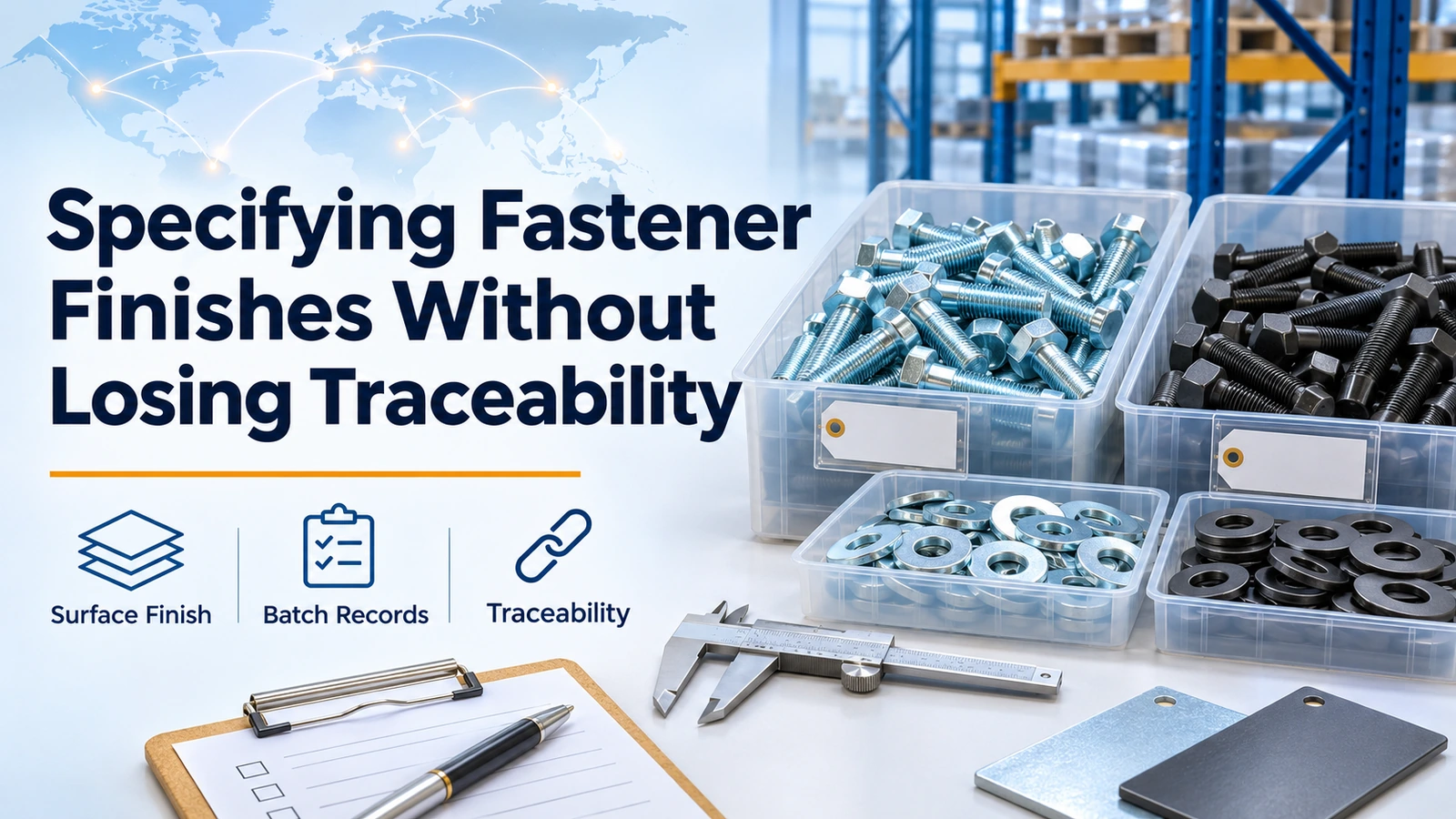
A finish name alone may leave important purchasing details unresolved. Buyers should connect the finish requirement to the approved material, mating parts and exposure review, then ask how the supplied lots will be identified. This guide focuses on documenting that decision rather than prescribing one coating for every environment.
What to confirm before requesting a quotation
Use the following six checkpoints as an enquiry worksheet. They are purchasing questions to resolve with the responsible parties, rather than universal product specifications. Record the accepted answer and any open exceptions for the actual order.
- Exposure description. Provide the actual project environment and location to the responsible reviewer rather than relying on the shorthand outdoor use.
- Approved finish. Use the finish designation accepted for the connection and request written identification of any offered alternative.
- Mating parts. Review the bolt, nut, washer and adjoining component requirements together so a finish change does not occur on one item unnoticed.
- Evidence scope. Agree the inspection or supporting documents needed for the finish and how they will identify the supplied lots.
- Packing separation. Require similar looking finishes and sizes to be separated and labelled to avoid accidental mixing at receipt.
- Substitution control. Record the technical and commercial approval of a finish change before production or shipment, including affected line items.
Product and project context
Fastening procurement must separate dimensional similarity from verified suitability. Two items can share a nominal thread size while differing in material, strength designation, finish, geometry or intended installation system. Buyers should record the complete designation and the relevant application requirements. The responsible designer selects load-bearing connections and determines the applicable approvals; a supplier comparison sheet is not a substitute for that decision.
For an anchor, establish the actual base material and intended use before discussing a replacement. Concrete, masonry and other substrates cannot be treated as interchangeable. Installation requirements are specific to the chosen product and may include defined drilling, cleaning, setting and inspection procedures. Obtain the manufacturer’s current instructions and the project review requirements. Do not publish or apply a universal torque, hole size or load value across different anchor models.
For bolts, nuts and washers, make the assembly visible in the purchase schedule. Specify each mating component, the applicable thread definition and any required markings or supporting documents. A reference photograph can help identify a style, but dimensions and material requirements should be written. If the supplier proposes a different standard or finish, have the project team review that proposal before approving the commercial substitution.
Receiving checks should preserve lot identity. Ask how mixed sizes and finishes will be separated and labelled, and keep acceptance records attached to the relevant order lines. Where material or test documents are required, agree their format and linkage to the supplied lots before dispatch. A generic certificate from an unrelated batch is not evidence for the shipment being received.
1. Exposure description
Provide the actual project environment and location to the responsible reviewer rather than relying on the shorthand outdoor use.
Put the requirement into a line-item record with a reference that will survive the entire transaction. Use the same identifier in the enquiry, supplier response, approval record and packing information. Record the source of the requirement: a drawing, an accepted specification, a manufacturer document or a decision from the responsible reviewer. Where a value is not yet known, mark it as awaiting confirmation and name the person expected to resolve it. A blank field is easily mistaken for permission to choose anything. A clearly assigned open question is much easier to manage. Keep the accepted response with the order so that receiving staff do not have to reconstruct the decision from several email conversations.
2. Approved finish
Use the finish designation accepted for the connection and request written identification of any offered alternative.
Ask what the offered evidence actually establishes. A photograph can show appearance and package identification, but it cannot by itself establish material composition or an engineered performance requirement. A drawing can define dimensions without confirming the properties of the delivered batch. A sample can answer one question while leaving another unresolved. Write down the scope of each review and the person authorised to accept its result. Where manufacturer instructions or project approval are necessary, obtain those documents for the exact offered product. If an alternative is proposed, keep its identity and exceptions visible until the responsible party has reviewed it. Avoid describing an unresolved submission as approved simply because its price is acceptable.
3. Mating parts
Review the bolt, nut, washer and adjoining component requirements together so a finish change does not occur on one item unnoticed.
Compare the commercial scope only after the requirement and offered identity are clear. Put units, package quantities, accessories, requested documents and delivery responsibilities beside the price. Ask whether the offer includes the evidence and preparation work you have requested, and distinguish included items from optional charges. Record the quotation currency, validity and assumptions affecting lead time. A low unit figure is difficult to interpret when one offer covers individual pieces and another covers assembled sets, or when the packing scope differs. Keep an exception column in the comparison. Resolve differences explicitly rather than quietly treating them as equivalent. This makes the award decision easier to explain and reduces disputes over what was included.
4. Evidence scope
Agree the inspection or supporting documents needed for the finish and how they will identify the supplied lots.
Connect every approval to the item reference and document revision it covers. Identify the decision being made, the evidence reviewed and any conditions that remain open. Before releasing work, confirm which technical and commercial conditions must be satisfied and who may issue the release. If a supplier later proposes a material, finish, model, source or packing change, record the proposal before it is implemented. Review its effect on interfaces, evidence, cost and delivery. Send the accepted revision to the affected parties and retire the previous instruction from active use. A change register does not have to be complicated: a dated record of the request, decision, responsible person and affected lines is often a practical starting point.
5. Packing separation
Require similar looking finishes and sizes to be separated and labelled to avoid accidental mixing at receipt.
Decide how the destination team will recognise the accepted supply before the goods leave the supplier. Give the receiver the relevant order references, package identities and expected quantities. Agree which checks will be completed on arrival and which documents must accompany the shipment. Keep any product-specific storage or handling instructions accessible to the warehouse team. If a discrepancy is found, preserve the identity of the affected package and record the observation before materials are mixed or redistributed. Use the agreed notification route and keep the final disposition linked to the original record. This approach supports a fair review because it preserves what was supplied, what was expected and what was actually observed.
6. Substitution control
Record the technical and commercial approval of a finish change before production or shipment, including affected line items.
Take one representative order line and ask a colleague who did not prepare the enquiry to explain what is being purchased. They should be able to identify the exact item, the applicable revision, the quantity basis, the required evidence and the delivery point without guessing. Then ask how a proposed alternative would be approved and how the receiver would check the shipment. If those answers are scattered across incompatible files, consolidate the accepted information before release. Repeat the exercise after a major change. The aim is not to generate paperwork for its own sake; it is to ensure that the supplier, buyer, reviewer and receiver are working from a shared and checkable instruction.
A working example for your enquiry file
Consider a buyer preparing an overseas project order and receiving two responses to the same enquiry. One supplier provides a clear answer to exposure description, while another leaves that point open. The buyer should ask for the missing information before treating the offers as equivalent. The same approach applies to mating parts: record the offered response, identify the evidence required and name the person who will decide whether it satisfies the enquiry. This is a purchasing illustration, not a report of a completed Tangding project or a promise of a particular result.
For the final review, give the accepted enquiry record to the person responsible for substitution control. Check that the agreed information can be traced to a recognisable part, package or document reference. If the order changes, update that same record and identify the superseded version. This closes the gap between the quotation decision and the practical handover. It also gives the buyer a clear basis for asking follow-up questions without relying on memory or an informal assumption.
Questions buyers often ask
What should I include about exposure description?
Provide the actual project environment and location to the responsible reviewer rather than relying on the shorthand outdoor use. Include the relevant drawing or written requirement and ask the supplier to identify any exception explicitly.
Can a sample or photograph settle the whole specification?
Define what the sample or photograph is intended to establish. Keep dimensional, appearance, material and performance questions separate, and obtain the evidence required by the responsible project reviewer. Acceptance of one characteristic does not automatically approve the rest of the specification.
How should an alternative be handled?
Ask for a clearly identified alternative with a written list of differences. Connect the proposal to the affected order line and obtain the required review before accepting changes to the specification, evidence, packing or delivery assumptions.
How do I make the handover easier?
Record the technical and commercial approval of a finish change before production or shipment, including affected line items. Keep the accepted record available to the receiving team and agree who handles any discrepancy.
Discuss your project with Tangding
Ningbo Tangding Supply Chain Management Co., Ltd. welcomes project-specific sourcing enquiries. Send the item list, drawings where applicable, quantities, destination and required delivery window. Confirm the offered product, available documentation, sample arrangements and commercial scope in the written quotation. Availability and services are subject to the requirements and acceptance of the individual enquiry.
Send your project enquiry · Explore related products and services · Quotation and ordering guide
Continue reading: Threaded Parts and Custom Fasteners: Drawing Review Before Purchase. Browse Anchors & Fasteners or all News and Insights.